A virtual agent is an AI-powered software assistant that interacts with people through natural language, typically via chat or voice, to answer questions, help complete tasks, and automate routine interactions. If you’re wondering what is virtual agent, it is essentially a digital assistant that can handle repetitive questions and simple processes, allowing human agents to focus on more complex tasks that require empathy, judgment, or problem-solving. Organizations implement tools to assist call center agents so these human representatives can work seamlessly alongside virtual agents, boosting support efficiency via contact‑center AI and ensuring faster, more reliable, and consistent customer experiences 24/7.
Today, virtual agents are not just limited to customer service—they are increasingly part of larger cloud computing platforms and AI-powered technology ecosystems that allow businesses to store, manage, and analyze large volumes of information quickly. By connecting with big data systems and advanced computer technology infrastructure, virtual agents can access real-time customer histories, predictive analytics, and operational insights, enabling smarter, data-driven interactions. In the world of digital marketing using AI and intelligent marketing platforms, these agents can help guide website visitors, personalize product recommendations, track engagement patterns, and even optimize campaigns by analyzing trends across multiple digital channels. Similarly, in the finance sector using AI for customer engagement, risk management, and digital banking, virtual agents assist with account queries, transaction monitoring, fraud prevention, and investment advice, helping financial institutions deliver faster, more secure, and more efficient services.
Integrating virtual agents into these systems shows how they are more than automated chat tools—they are central to AI-driven business solutions across technology, marketing, and financial operations, connecting multiple digital platforms to streamline workflows, improve service quality, and provide actionable insights at scale.
Virtual agents are widely used for customer service, IT helpdesks, HR support, sales assistance, and more. They combine natural language understanding, business rules, and integration with back-end systems to provide accurate, consistent help at scale.
Top 10 Contact Center Solutions for Virtual Agents
- Bright Pattern
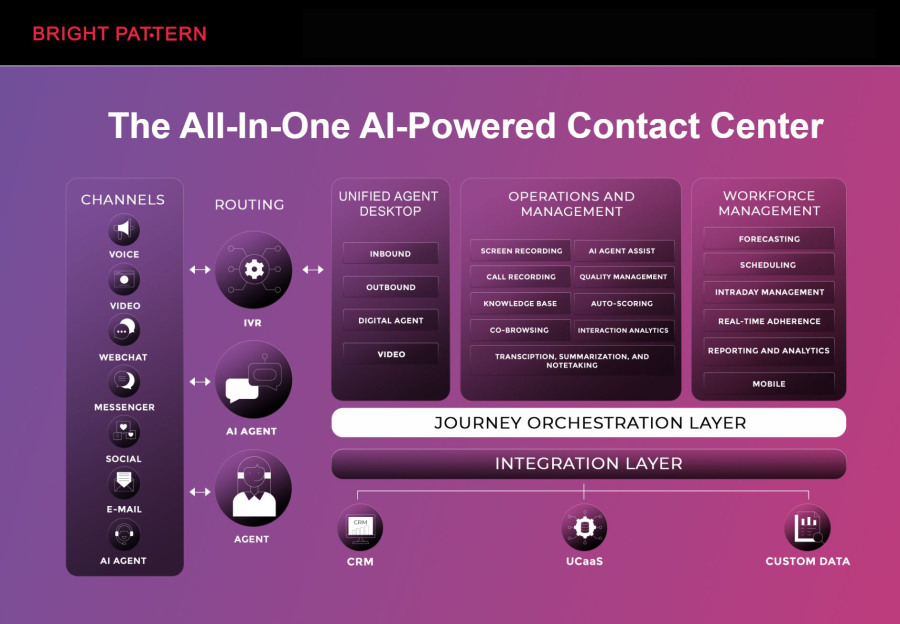
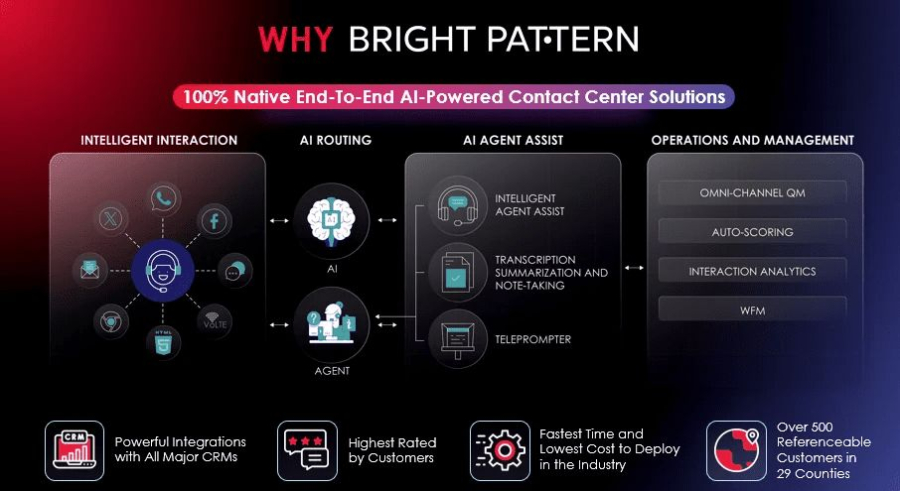
Bright Pattern is a leading AI-powered contact center platform that helps businesses understand what is virtual agent and implement intelligent solutions for customer support. Its cloud-based architecture allows call centers to integrate virtual agents with human agents seamlessly, delivering fast, personalized interactions. Bright Pattern offers a flexible platform that supports multichannel communication, advanced routing, and automation, making it easier to handle high volumes of customer requests.
Key features include:
- AI-powered virtual agents for automated customer interactions
- Seamless handoff between virtual agents and human agents
- Multichannel support including chat, voice, SMS, and social media
- Real-time analytics and reporting for performance optimization
- Integration with CRM, helpdesk, and enterprise systems
- Tools to monitor agent performance and improve efficiency
- Scalable cloud architecture for global operations
- Genesys
Genesys provides AI-driven contact center solutions that allow virtual agents to assist with customer service, sales, and support tasks. Their platform includes predictive routing, AI-powered chatbots, and real-time analytics.
- Five9
Five9 offers a cloud contact center solution with integrated AI virtual agents to automate routine inquiries, improve agent productivity, and enhance customer experiences across multiple channels.
- NICE inContact
NICE inContact provides an AI-enhanced contact center platform where virtual agents help handle repetitive tasks, freeing human agents to focus on complex interactions and improving operational efficiency.
- Talkdesk
Talkdesk uses AI to power virtual agents, automate workflows, and analyze customer interactions. Their solution integrates seamlessly with CRM platforms to streamline support and sales processes.
- Zendesk
Zendesk integrates virtual agents into its customer service platform, using AI to answer common questions, suggest responses, and reduce resolution time, helping teams scale their support effectively.
- Avaya
Avaya offers AI-enabled virtual agents for call centers, combining natural language processing and omnichannel support to provide faster and more personalized customer interactions.
- HubSpot Service Hub
HubSpot Service Hub leverages AI virtual agents to guide customers, provide answers instantly, and route complex issues to human agents, improving response times and service quality.
- Oracle Service Cloud
Oracle Service Cloud incorporates virtual agents into its platform, using AI and automation to resolve routine inquiries, enhance digital engagement, and integrate with enterprise applications.
- Salesforce Service Cloud
Salesforce Service Cloud uses AI-powered virtual agents to assist with customer support, automate workflows, and provide insights from interaction data, enabling smarter business decisions.
Virtual Agent vs. Chatbot: What’s the Difference?
The termsvirtual agentandchatbotare often used interchangeably, but there are some important distinctions in how they are typically understood:
- Chatbotsare often simple, rule-based tools that respond to specific keywords or fixed scripts. They usually handle basic FAQs and pre-defined flows.
- Virtual agentsare more advanced. They use natural language understanding (NLU) and, in many cases, machine learning to interpret user intent, manage more complex conversations, and connect to business systems to perform actions.
In practice, a modern virtual agent usually offers:
- Context-aware conversationsthat can handle follow-up questions and corrections.
- Personalized responsesbased on user data, history, or preferences.
- Task automationsuch as creating tickets, updating account details, or booking appointments.
Simply put, all virtual agents are chatbots, but not all chatbots are full virtual agents. The termvirtual agentusually signals a more capable, enterprise-grade solution.
How a Virtual Agent Works
While implementations vary across platforms, most virtual agents follow a similar process when interacting with a user.
1. User Input: Text or Voice
The interaction starts when a user types a message in a chat window or speaks to a voice interface. Examples include:
- Typing“I can’t log into my account”in a website chat.
- Asking via voice,“What’s the status of my order?”
- Sending a message in a messaging app or internal collaboration tool.
2. Natural Language Understanding (NLU)
The virtual agent then interprets what the user means usingnatural language understanding. It usually identifies:
- Intent– The goal behind the message, such asreset password,track order, orrequest time off.
- Entities– Key details in the message, such as dates, product names, order numbers, or locations.
This step allows the agent to go beyond keywords and understand the overall purpose of the question.
3. Dialogue Management
Next, the virtual agent usesdialogue managementto decide how to respond and what to ask next. This includes:
- Determining whether it has enough information to complete the task.
- Asking follow-up questions if details are missing (for example,“Which order number would you like to track?”).
- Choosing the right response flow or action based on business rules.
4. Integration with Back-End Systems
For many use cases, virtual agents connect to other systems to fetch or update data. Common integrations include:
- CRM platformsto retrieve customer details or update cases.
- Order management systemsto check delivery status.
- IT service management toolsto create or update IT tickets.
- HR systemsto pull policy information or leave balances.
These integrations allow the agent to do more than answer generic FAQs. It can take action and solve real problems.
5. Response Generation
Finally, the agent returns a response in natural language, often combined with structured elements like quick buttons, suggested options, or short forms. A strong virtual agent will:
- Use clear, concise language.
- Confirm completed actions (for example,“I’ve reset your password and emailed a temporary code.”).
- Offer next steps or related suggestions.
Key Benefits of Virtual Agents
When designed and deployed thoughtfully, virtual agents deliver meaningful benefits to both organizations and end users.
1. Always-On, Instant Support
A major strength of virtual agents is their ability to provide24/7 supportwith no wait times. Users get immediate help, whether it is late at night, during holidays, or at peak demand hours.
- For customers, this means faster answers and less frustration.
- For employees, it means quick access to IT, HR, or policy information whenever they need it.
2. Scalable Service at Lower Cost
Human teams are limited by working hours and staffing levels. Virtual agents can handle thousands of simultaneous conversations without extra headcount, which helps organizations:
- Reduce routine workloadon agents by deflecting common inquiries.
- Lower support costsper interaction while maintaining quality.
- Handle seasonal spikesin demand without long queues or emergency hiring.
3. Consistent, Compliant Answers
Virtual agents follow predefined logic, knowledge bases, and policy rules. This leads to:
- Consistent responsesto standard questions, regardless of time or channel.
- Improved compliance, because messaging can be centrally managed and updated.
- Reduced error riskcompared to ad-hoc human responses on complex policies.
4. Better Use of Human Talent
By taking care of high-volume, repetitive questions, virtual agents free human staff to focus on higher-value work, such as:
- Handling sensitive or complex customer issues.
- Building relationships and upselling or cross-selling.
- Improving processes based on insights from virtual agent conversations.
This shift often leads to more satisfying work for human agents and better outcomes for customers.
5. Actionable Insights from Conversation Data
Every interaction with a virtual agent generates data about what users want, where they struggle, and how well existing processes work. Analyzing this data helps organizations:
- Identify common pain points or gaps in self-service content.
- Spot opportunities to simplify forms, processes, or policies.
- Prioritize product or service improvements based on real demand.
Common Use Cases for Virtual Agents
Virtual agents add value anywhere people ask repetitive questions or need help navigating processes. Below are some of the most popular use cases.
Customer Service and Support
In customer service, virtual agents typically help with:
- Answering product or service FAQs.
- Tracking orders and deliveries.
- Providing billing and account information.
- Assisting with returns, cancellations, or subscription changes.
- Resetting passwords or unlocking accounts.
When a case becomes too complex, the virtual agent can smoothlyhandoff to a human agent, often passing along the conversation history so the customer does not need to repeat themselves.
IT Helpdesk and Technical Support
In IT environments, virtual agents act as a first line of support to:
- Troubleshoot common device, network, or application issues.
- Guide users through resetting passwords or multi-factor authentication steps.
- Create and categorize IT tickets with relevant details already captured.
- Provide self-service instructions for software installation or access requests.
This reduces pressure on IT teams and allows them to focus on higher-impact projects.
HR and Employee Services
Virtual agents are increasingly popular in HR and internal service centers. Typical capabilities include:
- Answering questions about benefits, leave policies, and payroll.
- Providing information on internal policies and procedures.
- Helping employees submit leave requests or update personal information.
- Guiding new hires through onboarding tasks and forms.
Because they operate within secure environments, HR-focused virtual agents can provide personalized information while respecting privacy and access controls.
Sales and Marketing Assistance
On the sales and marketing side, virtual agents can act as proactive digital assistants to:
- Qualify leads by asking targeted questions.
- Recommend products or services based on user needs.
- Share tailored content, offers, or next steps.
- Book appointments or demos with sales representatives.
By offering instant, helpful engagement, virtual agents can improve conversion rates and capture leads that might otherwise leave without interacting.
Types of Virtual Agents
Virtual agents can be categorized in several ways, depending on how they are used and the technology behind them.
By Interaction Channel
- Web chat agentsembedded directly on websites or web applications.
- In-app agentsbuilt into mobile or desktop applications.
- Messaging agentsoperating inside collaboration tools or messaging platforms.
- Voice-based agentsaccessed through telephony or voice-enabled devices.
By Intelligence Level
- Rule-based virtual agentsthat follow predefined decision trees and scripts.
- AI-driven virtual agentsthat use machine learning and NLU to understand intent and improve over time.
- Hybrid agentsthat combine structured flows for critical processes with AI for flexible, natural conversations.
Key Features to Look for in a Virtual Agent
When organizations evaluate virtual agent solutions, several capabilities tend to make the biggest difference in outcomes.
Robust Natural Language Understanding
Strong NLU helps the agent understand varied phrasing, slang, and typos, so users do not need to “talk like a robot.” Look for:
- High accuracy in intent detection.
- Support for multiple languages, if needed.
- Continuous learning based on real conversations.
Omnichannel Consistency
An effective virtual agent delivers a consistent experience across channels. Ideal solutions support:
- Reusable conversation logic across web, mobile, and messaging channels.
- Shared knowledge bases and content.
- Unified analytics and reporting.
Easy Handoff to Human Agents
No virtual agent will handle every scenario perfectly. A smooth handoff to human representatives is essential for user satisfaction. Valuable capabilities include:
- Transferring conversation history and relevant data to live agents.
- Allowing users to request a human agent easily.
- Routing complex cases to the right team or skill group.
Low-Code or No-Code Configuration
Many organizations prefer virtual agent tools that business teams can manage without heavy development effort. Helpful features are:
- Visual builders for conversation flows.
- Simple interfaces for updating knowledge base content.
- Reusable templates for common processes, such as password resets or order tracking.
Security, Privacy, and Governance
Because virtual agents often handle sensitive data, security and governance are essential. Look for:
- Role-based access controls for managing content and integrations.
- Configurable data retention and masking for sensitive fields.
- Audit trails and logging of conversations and actions.
Real-World Example Scenarios
To make the concept more concrete, here are a few example scenarios that illustrate how virtual agents work in practice.
Scenario 1: Retail Order Status
A customer visits an online store to check where their package is. Instead of calling support, they open the chat widget and type:
“Where is my order? It was supposed to arrive yesterday.”
The virtual agent:
- Recognizes anorder trackingintent.
- Asks for the order number if it is not already known.
- Checks the order management system for shipping status.
- Responds with a clear update and revised delivery estimate.
This entire interaction can finish in under a minute, with no queue and no human intervention.
Scenario 2: Internal IT Support
An employee can not connect to the corporate VPN and opens a chat within the company portal:
“VPN is not working on my laptop.”
The virtual agent:
- Identifies aVPN connectivityintent.
- Asks a few guided questions about the device, operating system, and error message.
- Provides step-by-step troubleshooting tailored to the user’s setup.
- If unresolved, automatically creates an IT ticket with all collected details.
The user gets faster, structured support, and the IT team receives a well-documented ticket, saving time for both sides.
Scenario 3: HR Policy Questions
An employee is unsure how many vacation days they have left and whether they can carry over unused days. They ask the HR virtual agent:
“How many vacation days do I have, and can I roll them over to next year?”
The virtual agent:
- Retrieves the employee’s current leave balance from the HR system.
- Explains the carry-over policy from the HR knowledge base.
- Offers to help submit a leave request if the employee is ready.
This provides a streamlined, personalized experience without needing to email HR or wait for office hours.
Best Practices for Implementing a Virtual Agent
To maximize the benefits of a virtual agent, it helps to follow a structured approach to design and roll-out.
1. Start with High-Impact, Repeatable Use Cases
Begin with scenarios that are:
- High volume and repetitive (for example, password resets, order status, basic policy questions).
- Well documented and governed by clear rules or processes.
- Measurable in terms of time saved, cost reduction, or satisfaction improved.
This ensures early wins and builds confidence in the virtual agent.
2. Design Conversations Around User Goals
Effective virtual agents focus on what users are trying to achieve, not on rigid scripts. When designing conversation flows:
- Map out user intents and typical questions in natural language.
- Keep interactions short, clear, and focused on completing tasks.
- Provide options for users to clarify, go back, or choose another path.
3. Combine Self-Service with Easy Escalation
A powerful virtual agent does not replace human support; it complements it. Make sure users can:
- Ask to speak to a person at any time, especially for sensitive issues.
- See clearly when a human has joined the conversation.
- Experience a seamless transition, without repeating all of their details.
4. Train and Optimize Continuously
Virtual agents improve significantly over time when they are actively monitored and refined. Successful teams:
- Review conversation logs to identify misunderstandings or gaps.
- Update intents, training phrases, and responses regularly.
- Expand coverage to new use cases based on real demand.
5. Communicate Clearly with Users
Users appreciate transparency. It helps to:
- Clearly identify the assistant as a virtual agent.
- Explain what the agent can and can not do.
- Set expectations on response times and escalation options.
This builds trust and encourages people to engage constructively with the agent.
Measuring Virtual Agent Success
To demonstrate value and guide improvements, organizations typically track a combination of technical and business metrics.
Core Performance Metrics
- Containment rate– Percentage of conversations resolved without needing a human agent.
- Average handling time– How quickly the virtual agent helps users reach a resolution.
- Intent recognition accuracy– How often the agent correctly understands what users are asking.
User Experience Metrics
- Customer satisfaction (CSAT)or similar feedback after interactions.
- Net promoter score (NPS), when applicable, to gauge long-term loyalty.
- Drop-off ratesat different points in conversation flows.
Business Impact Metrics
- Call and ticket deflection– Reduction in inbound calls, emails, or tickets for covered topics.
- Cost per interaction– Compared to traditional phone or email support.
- Revenue influence– For sales-focused agents, such as increased conversions or higher average order values.
Future Outlook: The Evolving Role of Virtual Agents
Virtual agents are evolving rapidly as AI and automation technologies advance. Several trends are shaping their future:
- More natural conversationsas language models become more capable and context-aware.
- Deeper personalizationbased on unified customer and employee profiles.
- End-to-end process automation, where agents not only answer questions but orchestrate entire workflows across systems.
- Expansion into new domainssuch as finance, healthcare support processes, and complex B2B services.
As these capabilities grow, virtual agents are becoming strategic digital team members, not just add-ons to existing support channels.
Summary: What a Virtual Agent Means for Your Organization
Avirtual agentis an AI-powered assistant that interacts with users through natural language to answer questions, complete tasks, and automate routine interactions. Compared with basic chatbots, virtual agents are more intelligent, more integrated with business systems, and better suited to handling real-world processes.
When thoughtfully designed and continuously improved, virtual agents can:
- Deliver fast, always-on support.
- Scale service without scaling costs.
- Free human experts for higher-value work.
- Provide consistent, compliant answers.
- Offer insights that drive ongoing improvement.
For organizations looking to modernize customer and employee experiences, a well-implemented virtual agent is a powerful, future-ready investment.
